
Grantees tackle rare PIs from basic biology to treatment
January 22, 2026

The more you understand about primary immunodeficiency (PI), the better you can manage it. Learn about PI diagnoses and treatment options.

Living with primary immunodeficiency (PI) can be challenging, but you’re not alone—many people with PI lead full and active lives. With the right support and resources, you can, too.

Be a hero for those with PI. Change lives by promoting primary immunodeficiency (PI) awareness and taking action in your community through advocacy, donating, volunteering, or fundraising.

Whether you’re a clinician, researcher, or an individual with primary immunodeficiency (PI), these resources will help you advance the field. Get details on surveys, grants, and clinical trials.
The Immune Deficiency Foundation is proud to fund four research projects totaling $200,000 through the 2025 Research Grant Program. The funded projects touch several different rare primary immunodeficiencies (PIs), also known as inborn errors of immunity (IEI), but could have broader impact both across other PIs and in larger fields like immunology and gene therapy.
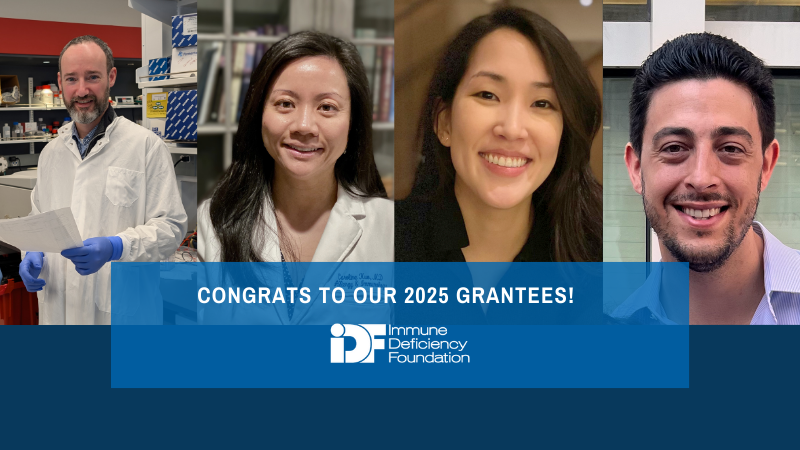
The 2025 Michael Blaese Research Grant Award goes to Dr. Eric Allenspach, an assistant professor at Seattle Children’s Hospital, who plans to develop a screening test, and ultimately, a gene editing strategy, for a form of IFNAR2 deficiency found in Inuit and Alaska Native communities.
First described in 2015, people with IFNAR2 deficiency are missing a crucial piece of the early warning system that alerts the body to a viral infection. Infected cells send out the warning, a protein called interferon I, but other cells can’t receive the signal. The body never activates its antiviral defenses, and the infection quickly gets out of control. People with IFNAR2 deficiency can suffer life-threatening infections from common viruses like COVID-19 or the flu, or from live, attenuated viral vaccines like the measles, mumps, and rubella (MMR) or varicella (chicken pox) vaccines.
In previous research, Allenspach was part of a team that discovered a genetic change, or variant, in Inuit and Alaska Native populations that causes IFNAR2 deficiency. The ‘Arctic’ variant is autosomal recessive, which means that someone has to inherit two copies of it, one from each parent, to have IFNAR2 deficiency. People with just one copy of the variant are carriers who don’t get severe viral infections.
What’s astounding is that about one in 25 people of Inuit or Alaska Native heritage are carriers of the Arctic variant. That means children of parents who are both Inuit or Alaska Native have a significant chance of inheriting IFNAR2 deficiency.
“Through partnership with the Tribal Health community-led groups in Alaska, we have created momentum to educate local providers and Alaska Native communities about the immunodeficiency condition and guidance around treatment approaches. However, many children remain untested without broader screening,” said Allenspach.
“Our research is to design an affordable genetic screening test for at-risk communities where traditional screening approaches are not possible.”
The screening test Allenspach hopes to develop will use well-established, inexpensive techniques, making it ideal for communities in the Arctic circle. In addition, Allenspach’s team plans to develop cell lines with the Arctic variant to use in the laboratory. These cell lines will allow the team to test out strategies for correcting the variant using different gene editing technologies. Gene editing is an advanced form of gene therapy that makes precise changes to cells’ DNA sequence rather than adding a full working copy of a gene, as in traditional gene therapy. The best of these strategies could then move into clinical development as a treatment for IFNAR2 deficiency.
Grantee Dr. Caroline Kuo is an associate professor at the University of California, Los Angeles, working on gene therapy to treat DOCK8 deficiency. A combined immune deficiency (CID) that was previously classified as a hyper IgE syndrome, people with DOCK8 deficiency have severe eczema and food allergies, and are susceptible to respiratory and skin infections. They also have a high risk of developing cancer, particularly cancers caused by human papillomavirus (HPV) and a type of blood cancer called lymphoma. Many don’t survive past 20 years of age unless they receive a bone marrow transplant (BMT; also known as a hematopoietic stem cell transplant).
DOCK8 deficiency is also a candidate for gene therapy. During gene therapy, a person’s own blood-forming stem cells get corrected so that they make a functional immune system. Gene therapy avoids some of the pitfalls of BMT—you don’t need to find a stem cell donor and there’s less risk of certain complications because the cells are the patient’s own.
However, the DOCK8 gene itself poses several challenges. First, the gene actually codes for several different versions of the DOCK8 protein, called isoforms. Right now, it’s unclear how important each isoform is to immune system cells or how different variants in the DOCK8 gene affect the levels and function of each isoform. Kuo wants to understand the relationship between deficiency-causing variants and DOCK8 isoforms to make sure her gene therapy strategy successfully corrects cells.
Another challenge is that the DOCK8 gene is large. Kuo’s team has previously tried fitting the entire gene into the hollowed out viruses, called viral vectors, that researchers typically use to get gene therapy cargo into cells. However, when the vectors were tested in the lab, only a small percentage of cells actually received the working gene. Kuo wants to try another strategy where researchers split the gene of interest into two pieces. Viral vectors then deliver each piece to cells separately. Once the halves are inside of the stem cells, the full protein is reassembled.
“The insights gained may inform therapeutic strategies for other primary immunodeficiencies caused by large or complex genes, thereby benefiting the wider primary immunodeficiency community,” said Kuo.
“This research project addresses a major gap in our understanding of activated phosphoinositide 3-kinase delta syndrome (APDS): why allergic inflammation is so common in affected patients,” said Dr. Ashley Lee, an instructor at Columbia University Irving Medical Center.
APDS is an ultra-rare PI that makes affected people vulnerable to respiratory infections and chronic infections with herpesviruses like Epstein-Barr virus (EBV). People with APDS can also develop certain types of autoimmunity, where the immune system attacks healthy organs and tissues. In addition, their bodies make too many white blood cells, leading to swollen lymph nodes or an enlarged spleen or liver. This lymphoproliferation can eventually progress to lymphoma, a type of blood cancer.
On top of everything else, many people with APDS also suffer from allergic symptoms, such as food allergies, hay fever, asthma, and eczema. The last step in these allergic reactions is when IgE antibodies bind to immune system cells called mast cells and cause them to release chemicals like histamine when they come across allergens. This degranulation is what causes the immediate symptoms of allergies. T cells and B cells are involved too, upstream of IgE and mast cells.
So far, researchers don’t know exactly why people with APDS have allergies. It’s also unclear if leniolisib, the first specific treatment for APDS, affects these symptoms.
Lee’s hypothesis is that APDS-causing genetic variants prime the immune system to make IgE and activate mast cells.
“This research support…allows us to focus on patient-relevant symptoms—such as allergies and immune overactivation—that are often overlooked but have a major impact on daily life,” she said.
Lee plans to use base editing technology to introduce APDS-causing genetic variants into T cells and mast cells in the lab. By looking at the chemical signals that edited T cells make, she hopes to show that these variants push the cells toward a type of signaling that causes the B cells they interact with to develop into plasma cells that pump out IgE. Similarly, Lee hopes to show that degranulation in edited mast cells is easier to trigger. She also plans to test whether leniolisib affects any of these processes in the edited T cells and mast cells.
Dr. Patrick O’Connell is a resident at Mount Sinai Kravis Children’s Hospital interested in lysinuric protein intolerance (LPI). While LPI is a PI, it’s better known as a metabolic disorder because it affects the body’s ability to use certain nutrients.
“It is becoming increasingly recognized that specific inborn errors of metabolism are also primary immunodeficiencies, yet there has been little research to understand how the two are linked and how to best optimize immune function in these individuals,” he said.
People with LPI can’t process specific amino acids like lysine, arginine, and ornithine. Amino acids are the building blocks for proteins, so some LPI symptoms, like vomiting and poor growth, stem from an inability to handle the protein in food. Other symptoms, like the buildup of ammonia in the blood, come from lacking these specific amino acids when and where they’re needed.
However, one of the most dangerous and least understood symptoms of LPI is smoldering hemophagocytic lymphohistiocytosis (HLH). HLH is an extreme form of inflammation that causes collateral damage to healthy organs and tissues. Symptoms include a high fever, enlarged spleen, liver, or lymph nodes, low blood counts, and neurological problems like confusion or seizures. If it’s not caught in time, HLH can cause organ failure and death. While HLH usually progresses quickly, smoldering HLH builds over a longer period of time, making it even harder to catch. Immunologists struggle to manage inflammation in patients and prevent HLH because it’s unclear how LPI leads to HLH.
O’Connell has honed in on this aspect of LPI and is hoping to provide insight that can be translated into better care. He will use the grant funds to look for differences in the proteins and immune system cells found in the blood of people with LPI compared to people without LPI. Looking at these differences could help O'Connell's team work backwards to link LPI inflammation to how the body processes amino acids.
In an additional set of experiments, O’Connell plans to test medications that are already used to fine-tune immune responses in other conditions on immune cells from people with LPI. Medications that block pro-inflammatory signals in these cells could give immunologists a starting point for managing inflammation in people with LPI.

Receive news and helpful resources to your cell phone or inbox. You can change or cancel your subscription at any time.