Newest NAC members bring geriatric and pediatric expertise
July 15, 2025

The more you understand about primary immunodeficiency (PI), the better you can manage it. Learn about PI diagnoses and treatment options.

Living with primary immunodeficiency (PI) can be challenging, but you’re not alone—many people with PI lead full and active lives. With the right support and resources, you can, too.

Be a hero for those with PI. Change lives by promoting primary immunodeficiency (PI) awareness and taking action in your community through advocacy, donating, volunteering, or fundraising.

Whether you’re a clinician, researcher, or an individual with primary immunodeficiency (PI), these resources will help you advance the field. Get details on surveys, grants, and clinical trials.
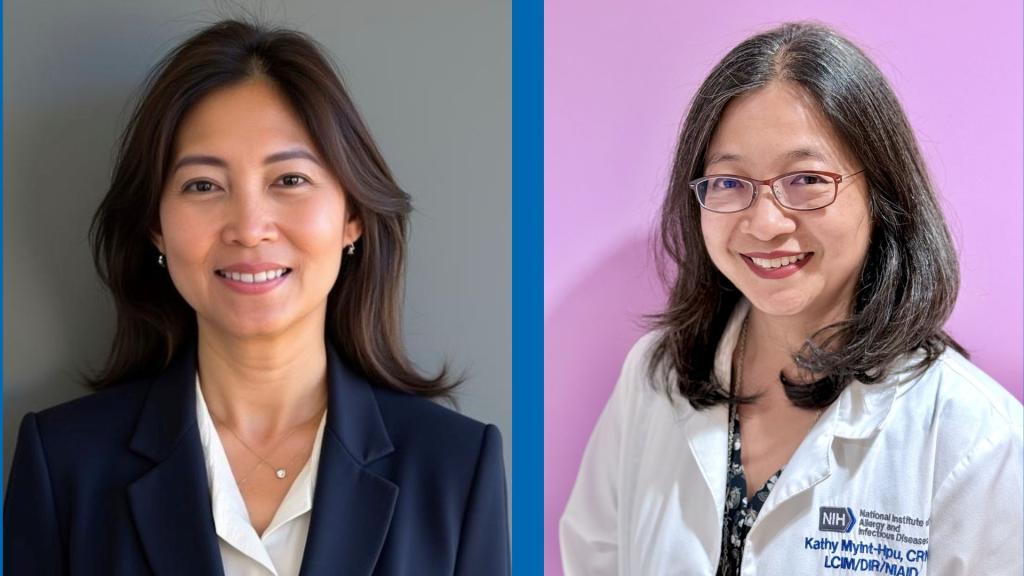
IDF’s Nurse Advisory Committee (NAC) has appointed two new members, Dr. Thu Michelle Tran, who manages an immunology infusion center that serves mostly seniors with primary immunodeficiency (PI), and pediatric nurse practitioner Katherine Myint-Hpu, who cares for children and young adults with PI, including rare diagnoses such as severe combined immunodeficiency (SCID).
An all-volunteer committee, NAC members have nursing backgrounds and practice in PI-related fields. The group meets quarterly and supports the foundation by developing resources like the Traveling with PI checklist and the IDF Guide for Nurses.
Tran, an advanced nurse practitioner, practices at the University of California, Irvine Health School of Medicine, where she provides care for those with PI receiving immunoglobulin (Ig) replacement therapy. She also supports the allergy/immunology fellowship program and research studies.
“We do more than just patient care in our department. We are raising awareness of PI through patient and physician education seminars, along with facilitated research and clinical trials,” explained Tran.
Prior to nursing, Tran used her bachelor’s degree in microbiology to forge a career advancing bone marrow and umbilical cord stem cell transplantation for leukemia. She worked for the National Marrow Donor Program for eight years.
Tran then took a research position at the Children’s Hospital of Orange County (CHOC), which required a nursing background, so she earned a combined bachelor’s and master’s degree in nursing. In 2009, she transitioned to the infusion center position and earned her doctorate in nursing.
“I didn’t choose nursing. It chose me. Everything was based on my faith. I think God has a plan for me. He just nicely opened the door at the right time. So, it’s by a leap of faith that I ended up being a nurse, and I love what I am doing,” said Tran.
Tran focuses on optimizing the Ig replacement therapy experience for patients and reducing infusion-related side effects. This is of particular importance in PI patients over 65 who often have other health conditions that complicate treatment and raise the risk of adverse reactions. Tran is particularly interested in research studies to investigate the correlation between infusion rates and side effects, and intravenous immunoglobulin (IVIG) and subcutaneous immunoglobulin (SCIG) options for geriatric patients to improve quality of life.
Tran has witnessed much change in Ig therapy during her career at the infusion center.
“On the positive side, patients have more choices when it comes to products, and pharmaceutical companies offer greater support and services. On the downside, health insurance coverage for treatment has become a more formidable hurdle with each passing year,” said Tran.
Approval and reimbursement for Ig treatment is becoming increasingly more difficult with both private and public (Medicare and Medicaid) health insurance. The denial of claims requires more time and effort on the provider’s end to advocate for proper care for their patients and sometimes interferes with what providers think is the best treatment for their patients.
“Some days, I spend more time working on prior authorizations or peer-to-peer appeals for my patients than I do on direct patient care. And I’m pretty sure it’s common across the board for all providers,” said Tran.
Always keeping her patients’ best interests in mind, Tran refers patients to IDF for materials and support. She looks forward to contributing her knowledge on seniors with PI to the next edition of the IDF Patient and Family Handbook, particularly when it comes to preparing for retirement with PI.
She also wants to raise awareness of PI in underserved groups, with special emphasis on the Vietnamese community in Orange County, California, which is the largest Vietnamese population outside of Vietnam. Tran hopes to help with translating some IDF materials into Vietnamese to aid this community’s understanding of PI.
“I believe every PI patient should have the best quality of life at any age and from any demographic, and I want to help my patients achieve just that,” said Tran.
In contrast to Tran, new NAC member Myint-Hpu works with the youngest of PI patients as a pediatric nurse practitioner with the National Institute of Allergy and Infectious Diseases (NIAID) at the National Institutes of Health (NIH). She sees patients who have rare PIs such as Wiskott-Aldrich syndrome (WAS), STAT1 gain of function, various types of SCID, including RAG1 and RAG2 deficiencies, as well as recently identified PIs such as SASH3 deficiency, a combined immunodeficiency. Patients with difficult-to-diagnose PIs also visit the NIH.
“The patients we see here at the NIH Clinical Center are referred from their home physicians to be evaluated on our natural history protocol, ‘Investigating the Mechanistic Biology of Primary Immunodeficiency Disorders.’ Many are patients who are followed by immunologists but may present with something unusual, so we serve as a second opinion. Some present with new genetic diagnoses or are self-referrals seeking more information about their conditions,” said Myint-Hpu.
“We bring the patients here for comprehensive evaluations, including whole genome sequencing, and make recommendations for management. We sometimes refer patients to other groups at the NIH running clinical trials for bone marrow transplant (BMT) in patients with PI.”
Among her other duties, Myint-Hpu performs clinical procedures, such as collecting bone marrow, skin, and spinal fluid samples from patients. Some have struggled with PI for many years before finding their way to NIH and suffer from chronic health problems due to organ damage and other lasting effects of infection.
“As a pediatric nurse practitioner, I’d like to get the word out to pediatricians about PI. So many times we see kids later on. Their caretakers will say, ‘They’ve always been sickly. They have a cold all the time.’ Well, that’s not normal to be ‘sickly all the time,’” said Myint-Hpu.
Myint-Hpu holds a joint master’s degree in nursing and public health from Yale University, specializing in pediatrics and international health. Before serving PI patients, Myint-Hpu worked with pediatric oncology patients for over a decade at Georgetown University Hospital.
“I find that both types of patients are very similar. Both have potentially life-threatening conditions, so the relationship that the provider develops with the patient and family is a very personal and often lifelong one,” said Myint-Hpu. “It’s also very rewarding to see my patients get better with treatment and even sometimes be cured.”
Myint-Hpu transitioned into the NIH Pediatric Consult Service Clinical Center in 2014, which eventually led to her current position, which she began in 2020.
“I am excited to be a part of the NAC and look forward to supporting the mission of IDF. I would like to help educate primary care providers about primary immune deficiencies in the hopes of facilitating earlier diagnoses and treatment, which can prevent long-term complications and save lives,” said Myint-Hpu.

Receive news and helpful resources to your cell phone or inbox. You can change or cancel your subscription at any time.