
Teen with STAT3-hyper IgE syndrome is driven to win
October 13, 2026

The more you understand about primary immunodeficiency (PI), the better you can manage it. Learn about PI diagnoses and treatment options.

Living with primary immunodeficiency (PI) can be challenging, but you’re not alone—many people with PI lead full and active lives. With the right support and resources, you can, too.

Be a hero for those with PI. Change lives by promoting primary immunodeficiency (PI) awareness and taking action in your community through advocacy, donating, volunteering, or fundraising.

Whether you’re a clinician, researcher, or an individual with primary immunodeficiency (PI), these resources will help you advance the field. Get details on surveys, grants, and clinical trials.
This article was first published in the Fall 2026 edition of the ADVOCATE newsletter.
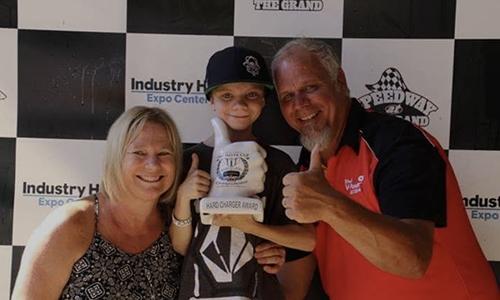
When Colton Nelson raced motorcycles as a youth, he rode his bike in motocross competitions, around dirt tracks and up hills that sent him flying 10 feet in the air. Landing after those jumps isn’t the hardest part of the race, said Nelson. Having to stand up for lap after lap and steer around corners with deep ruts and across hundreds of braking bumps is what really takes a toll on the body.
“You are using every muscle in your body at that point, because you’re holding on over the bars and using your legs at an angle to squeeze the bike,” said Nelson, 19, who has since transitioned to racing cars. “And it’s not a team sport. Once you’re on the track, it’s all you. So, you’re fighting everybody else who wants to win just as badly as you do.”
Racing requires the same self-reliance and determination as another significant part of Nelson’s life—his diagnosis of hyper IgE syndrome (HIES), an ultra-rare primary immunodeficiency (PI).
“Living with a PI, you always have something going on and you’re never healthy like a normal person. You're always dealing with something,” said Nelson. “I think when you have to commit and fight that infection, that transfers over to the racing, because that’s what racing teaches you—to fight and push through.”
Colton’s form of HIES, also known as Job syndrome, is caused by changes in the STAT3 gene that lead to high levels of IgE antibodies, severe eczema, and frequent skin and lung infections. An autosomal dominant condition, in which an affected parent has a 50% chance of passing along the variant, HIES can occur in both males and females.
Symptoms of HIES began for Nelson in infancy. He developed rashes and allergies to foods, including his formula and dairy. He fought frequent infections. Pneumonia collapsed his lung as a toddler and required surgery to treat. A doctor diagnosed him with HIES at 4 and he started treatment with monthly intravenous immunoglobulin (IVIG) replacement therapy.
Around the same time, inspired by his interest in riding a mini-dirt bike around their farm, his parents asked a friend to teach Nelson how to ride a dirt bike competitively. He entered his first youth motocross race at 5. Every Friday, his mother and father loaded up the small motorcycle on a trailer and drove from their home in Auburn, Calif., to a race a few hours away. The next day, they’d wake up and drive to the next race, and do the same thing on Sunday.
“I was happy it was going on, but I’m sure my parents were doing that because they didn’t know how long I had. They really didn’t. My doctor said it was surprising I even made it because he said most children with my condition don’t make it past age 3,” said Nelson.
Nelson raced motocross on traditional outdoor dirt tracks with sharp turns and jumps; on off-road trails over rocks and logs in a form of the sport called enduro; and supercross in stadiums on man-made tracks that are tight, steep, and filled with obstacles.
The teen’s racing skills shone especially brightly in speedway, a type of race where the bike has no brakes, and riders have to lay the bike sideways on turns to slow it down. He racked up over 100 speedway championship wins, including earning third place twice in a national contest, and first place in both the American Motorcyclist Association and International Motorcycle Federation’s Junior Speedway Silver Cup Championship and the World Famous Gumball Rally.
As Nelson’s wins increased, the physicality of motorcycle racing placed tremendous stress on his body, as did symptoms from HIES. He kept on racing even with health challenges like ear and nose infections, chronic thrush, rashes, fungal infections, and methicillin-resistant Staphylococcus aureus (MRSA) infections.
The one effect of HIES on Nelson’s body that he couldn’t ignore, though, was bone weakness. The STAT3 gene controls not only functions in the immune system, but also bone and tissue development. Nelson developed osteoporosis and broke 15 bones during his motorcycle racing career. One crash broke his arm and hand, another shattered his arm again, this time in two places.
The race that ended his motorcycle racing happened during a supercross event. Nelson, 15 at the time, hit a jump, didn’t clear it, and landed so hard the force traveled through the bike’s suspension into his body. The impact broke his shin bones and calf bones in both legs, his ankle, and foot.
“When I broke other bones, the pain was never too bad. I just felt heat and numbness. But for the legs, it was immediately the worst pain I ever felt in my life. I just fell over and I was screaming,” said Nelson.
Doctors in the emergency room pulled on one leg and realigned it while Nelson was awake and on pain medicine, but surgeons had to repair the other leg with two metal plates and 27 screws. Nelson spent over a week in the hospital, three months using a wheelchair, and two weeks using a walker. He eventually was able to use boots and crutches and returned to school that calendar year.
Nelson said he’ll probably still ride dirt bikes around his family’s 18 acres to check on the cattle and for enjoyment, but dirt bike racing is out.
“Definitely no more tracks because you can’t justify that with osteoporosis. It’s disappointing because it’s really everything, it’s what I love to do, but sometimes it’s just not worth it,” said Nelson.
A few years before he ended his motorcycle racing career, Nelson transitioned to racing a mini-cup car. About half the size of a regular stock car, a mini-cup car is about 8 feet long and 3 feet tall and travels up to 70 mph on a track.
“It was fun, and that’s what matters is the fun,” said Nelson.
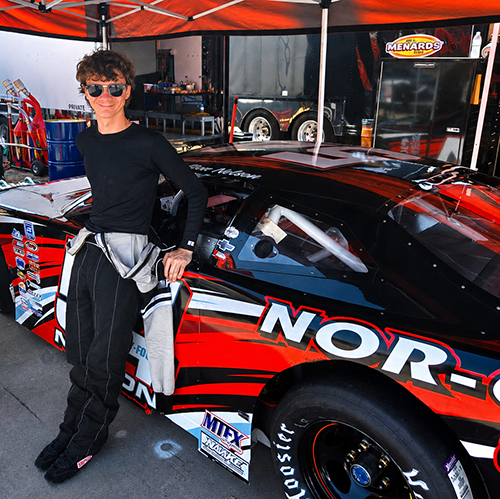
Today, Nelson races stock cars professionally at the All-American Speedway in Roseville, Calif. Known by his racing name “Colt45,” he has sponsors, a race car, and a racing team including a crew chief and a spotter. Wearing a one-piece flame-retardant racing suit, gloves, and helmet, he slides his 5-foot-6 frame through the window of the car and into a seat that locks his helmet into place.
Since he can’t turn his head to see other drivers beside or behind him, he relies on his spotter as he makes laps moving at up to 150 mph. The spotter tells Nelson who’s in his blind spots, guides his passing maneuvers, and warns him of crashes ahead. Unlike motorcycle races, which take about 30 minutes, car racing can take two hours and is much more strategic, said Nelson.
“The atmosphere inside the car is super-hot, up to 130 degrees. You’re always sweating. You’re steering a lot when you come into the corner. If you’re side-by-side with someone, there’s no traction control, no assist on the car, so you’re breaking traction all the time, you’re sliding, and you’re having to use your feet because we drive with both feet,” said Nelson.
Nelson races monthly, and when he’s not on the track, he’s either working as a food runner in a local restaurant or attending classes at the community college where he intends to earn a degree in magnetic resonance imaging (MRI) technology.
In March 2024, Nelson became a patient at the National Institutes of Health (NIH) in Washington, D.C. The NIH medical team diagnosed him with osteoporosis and provided him with medication, zoledronic acid. Zoledronic acid, administered through intravenous infusions every few weeks, slows down the progression of bone breakdown and increases bone density. The NIH continues to monitor Nelson’s health, including the growth of a cyst in his brain. He’s hopeful about the rapid pace of research related to treating those with PI.
“The fact that medicine is advancing every year is enough to fight to see the next year because you never know, they could break through and find something that could help you a lot,” said Nelson.
When he was younger, Nelson didn’t like to reveal his diagnosis to others, but now he’s come to understand living with a rare PI makes him unique. He stays positive, finds the energy to race, and follows his passion no matter the circumstances.
“I think it helps me knowing that I’ve gone through all of this, more than any of these other people I'm racing against, and I'm still here, I’m still racing,” said Nelson.


Receive news and helpful resources to your cell phone or inbox. You can change or cancel your subscription at any time.