

IDF logo
Man swabs his cheek for a genetic test.

Genetic testing

Key points:

  • Genetic testing is an important part of diagnosing many primary immunodeficiencies (PIs) and can help your healthcare providers develop a personalized treatment or management plan for your condition.
  • In general, genetic testing for PI does not provide results for other genetic conditions unless they are part of the ACMG recommended secondary findings list.
  • Genetic testing can help identify people who do not yet have symptoms of PI, including family members at risk of developing PI.
  • If genetic testing does not lead to a genetic diagnosis, the results can be reanalyzed every few years as new information becomes available. 

What is genetic testing?

Primary immunodeficiencies (PIs), also known as inborn errors of immunity (IEIs), are conditions caused by changes in a person’s DNA. Four nucleotides make up DNA: adenine (A), thymidine (T), guanine (G), and cytosine (C). The order of these nucleotides, or the DNA "sequence," is a code. This code contains instructions for making proteins, cells, and organs, similar to how a specific order of alphabet letters form words, sentences, and paragraphs. Each stretch of DNA that codes for a particular protein or other molecule is called a gene.
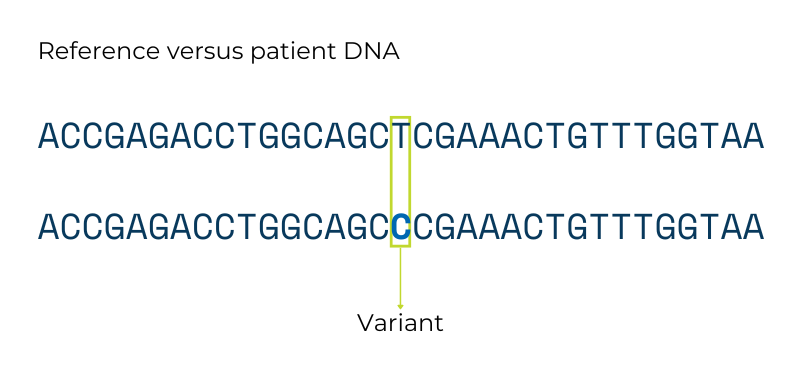
When patient DNA shows a difference in sequence relative to reference DNA, that difference is known as a variant.
A genetic variant is a difference between the sequence of a person’s DNA compared to another person’s DNA or a reference sequence.

Unless two people are identical twins, their DNA sequences have millions of differences across genes, which are known as genetic ‘variants.’ These genetic variants between people lead to differences in all kinds of traits like height and blood type. Genetic testing looks for these variants. Most variants do not really change the overall genetic instructions and do not cause genetic disorders. However, some variants change the instructions a lot, and those types of variants can cause genetic conditions like PI.

Healthcare providers use genetic testing to look for gene variants that are likely to cause PI symptoms. They can use genetic testing to confirm a diagnosis that was made based on clinical symptoms or blood test results, or to find a more precise diagnosis if a person’s symptoms or test results don’t point to one particular disorder. When there is a strong family history of PI, genetic testing can also determine if someone who does not yet have symptoms is at high risk for developing PI.

Results from genetic testing can not only provide a genetic diagnosis, but can also affect treatment and clinical management. For example, there are now some medications that are targeted to specific genetic PIs. Genetic testing can also be important for family planning decisions, and knowing whether relatives are at risk of PI. For example, several genetic variants that are passed down in families in different ways cause chronic granulomatous disease (CGD). Knowing which variant a person with CGD has and how it’s passed down is important for family planning and understanding who else in the family is at risk.

Genetic testing is a powerful tool. However, it’s important to understand that all of us have differences in our DNA compared to other people, and not all genetic variants are harmful or cause medical conditions. Most genetic variants are like the American versus British spellings for words like gray—the variant doesn’t change how the gene works. In addition, the genetic cause of some of the most common PIs, such as common variable immune deficiency (CVID), remains unknown, and some patients who have genetic testing will not receive a genetic diagnosis. 

Types of genetic tests
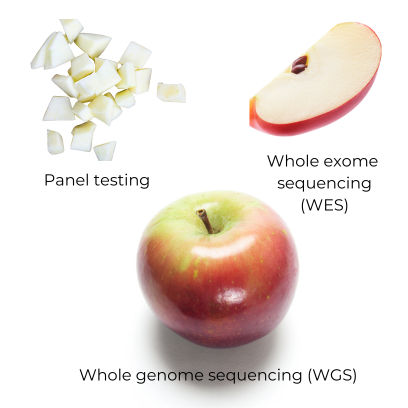
apples chopped, sliced, and then a whole apple
Panel testing, whole exome sequencing (WES), and whole genome sequencing (WGS) all look at a person’s DNA sequence. Panel testing is like looking at specific chunks of an apple, whole exome sequencing is like looking at a slice of an apple, and whole genome sequencing is like looking at the entire apple.

Generally, there are four types of genetic testing commonly used to diagnose PI: panel testing, whole exome sequencing (WES), whole genome sequencing (WGS), and chromosomal microarray (CMA). The first three use the same type of technology, which reads a person’s DNA sequence. The CMA test does not specifically look at the DNA sequence but detects when stretches of DNA are missing or duplicated. These duplicated or deleted stretches may contain parts of a gene, one or more whole genes, or important DNA sequences for controlling when genes are turned on or off.

The different types of testing can all provide a PI diagnosis, but they differ in the numbers of genes tested and type of genetic information they provide. In addition to your healthcare professional, you may meet with a genetic counselor or a physician who specializes in genetic disorders (geneticist) to discuss genetic testing. Genetic counselors are trained to help you understand testing options and genetic conditions. With any genetic testing, the person getting tested and the healthcare provider ordering the test should understand the test’s limitations. 

There are some situations where your healthcare provider may order a type of genetic test that is different from the ones listed here. For example, one of the more common forms of CGD can only be detected by an older but still very useful method of genetic testing called Sanger sequencing that looks at one gene at a time [1].

Panel testing is the most widely available type of genetic testing. It looks for variants in a limited number of genes, typically several hundred, that are already known to be related to a particular diagnosis or set of diagnoses. While this is the most limited type of genetic test, it is focused on known PIs and genetic variants and will provide a genetic diagnosis for many PIs caused by variants in single genes.

However, it is possible to get a false negative result from a panel. This means that the person has a PI caused by a gene variant, but the panel test did not find the variant. A false negative result can happen if the panel does not ‘cover’ the variant the person has. For example, the panel may not include all of the genes associated with PI or may not cover all parts of the genes it does include.

Note that panels for the same diagnosis can differ between different testing laboratories and the details of what a panel does and does not cover affect the results. Some panels only include the most common genes linked to a disorder; others may not be updated with genes that have only recently been linked to a condition. Often, panels only include the parts of a gene that code for its protein or other molecule (known as ‘exons’), which means that variants in non-coding regions may be missed. While most genetic variants associated with PI are in exons, variants in these non-coding regions can also cause PI.

Whole exome sequencing (WES) is broader than panel testing and picks up variants in all of the exons of all 20,000+ human genes [2]. In addition to what panels find, WES can turn up variants in genes that:

  • Are linked to PI but are not included in available panel tests.
  • Have not previously been linked to PI but have a known function in the immune system.
  • Have not been previously linked to PI or the immune system.

Since WES turns up many variants in many genes, how the data are analyzed is key to getting useful information. A study in the United Kingdom of more than 49,000 people found that each person, on average, had thousands of variants identified by WES [3]. If WES only finds variants in genes that haven’t been linked to PI before, it can be difficult to make sense of the data. In this case, your provider or a genetic counselor may be able to recommend a research study to help make sense of the data, if one is available.

In the past, healthcare providers generally used WES as a second-tier test when panel testing did not identify a PI-causing variant, but it’s being used as a first-tier test more and more often. Like panels, WES returns only variants in exons, not variants in non-coding DNA. The analysis of WES data also prioritizes genes most relevant to the condition for which the person is being tested.

Whole genome sequencing (WGS) is the most complete type of genetic testing available. WGS sequences all of a person’s DNA, including exons, non-coding bits in a gene called introns, and non-coding regions between genes. In addition to the types of variants WES can detect, WGS can also detect:

  • Structural variants, which are large pieces of DNA that are duplicated, deleted, or in the wrong place. For example, 22q11.2 deletion syndrome can be diagnosed with WGS but is generally not detected by WES [4].
  • Non-coding areas within and between genes, which may have sequences important for turning genes on and off.

Again, how WGS data is analyzed is critical to getting useful information. WGS turns up even more variants than WES, which means even more potential leads to follow up. Similar to WES, individuals may need to enroll in research studies to interpret WGS results that do not reveal an obvious PI-causing variant.

Chromosomal microarray testing (CMA) looks broadly to see if pieces of DNA are missing (deletions) or if there are ‘extra’ copies of DNA (duplications). The duplications and deletions CMA detects are typically much larger than what sequencing-based tests detect. CMA testing may be used alone or in combination with other types of genetic testing [5]. Some of the reasons a healthcare provider may order CMA include:

  • Testing for certain PIs that are caused by deletions in a person’s DNA like 22q11.2 deletion syndrome, Jacobsen syndrome (chromosome 11q deletion syndrome), chromosome 10p12-p14 deletion syndrome, and deletions in chromosome 14q32 associated with antibody deficiency.
  • For individuals with neurodevelopmental disorders and immune deficiency, including a CMA with other genetic testing can help determine if a single diagnosis accounts for all of the person’s symptoms. 
  • Added on to panel or WES testing, CMA can determine if one copy of a gene has missing pieces, which might not be detected with the other tests.

Genetic testing has unique risks

Information from genetic testing is more sensitive than other types of medical information. In 2008, Congress passed the Genetic Information Non-discrimination Act (GINA) [6]. GINA bans employers and health insurance companies from using genetic information in employment or coverage decisions. GINA also clarifies that genetic information is a type of medical information that falls under the Health Insurance Portability and Accountability Act (HIPAA) privacy rules.

However, GINA has limits. For example, the military does not have to follow the employer rules and can use genetic information in employment decisions. In addition, genetic information can legally be used to determine if someone qualifies for life or long-term care insurance. Law enforcement can also force healthcare providers or testing laboratories to share genetic information from medical records, which could link someone or their relatives to a crime [7].

Some states have passed additional genetic information privacy laws that are broader than GINA [8]. For example, a 2021 Connecticut law makes it illegal for companies to use genetic information for coverage decisions for many types of insurance. 

In addition to being used in ways you may not agree with, your genetic testing results can reveal information you may not be prepared for. This information can range from learning that you have a genetic condition aside from PI (secondary findings) to learning that the people who raised you are not your biological parents. Genetic counselors can help people understand and think through these possibilities before undergoing genetic testing.

Genetic testing results

Because the goal of genetic testing is to find variants causing a particular condition, computers analyze the raw sequence data to look for the variants most likely to cause PI. Genetic testing reports provide details on the variants that were found, if any.

People undergoing genetic testing should talk to their healthcare provider or a genetic counselor about the meaning of the testing, including:

VUSs are variants that do not have enough evidence to determine whether they affect the immune system in a way that causes PI or not. It is very common to have VUSs reported on your genetic testing results. Your healthcare provider will work with you to figure out whether you should be concerned about any VUSs or not.

Secondary findings are genetic variants linked to conditions other than PI. Note that laboratories only report secondary findings for a specific set of genes linked to conditions that are serious, but treatable, and only if the individual or their caregiver choose to receive this information.

In genetic testing, getting a positive test result means that the test found a genetic variant that causes PI. In the report, this variant may be labeled pathogenic or likely pathogenic. This means that there is strong scientific evidence that the variant found in your DNA disrupts the immune system in a way that causes PI symptoms.

A positive test result can also mean that you are a carrier for PI. This means that you have one copy of a genetic variant that is associated with a condition, but it is not enough to cause the condition. Knowing you are a carrier may influence your family planning decisions.

Indeterminate results in genetic testing mean that no pathogenic or likely pathogenic variants were found that cause PI but that one or more VUSs were found. While VUSs may be detected in raw genetic data, not all laboratories report them unless the provider ordering the test asks for them to be included. In many cases, your healthcare provider will decide whether there is additional testing that can help to determine whether a VUS may be linked to PI, which often includes testing family members.

For genetic testing, a negative result means that no pathogenic, likely pathogenic, or VUSs were found. However, a negative result does not mean that there is no genetic variant causing your PI. There are certain types of variants, such as those involving large sections of DNA, that standard sequencing methods do not detect well. In addition, specialized analysis of the raw data may be necessary to detect some genetic causes of PI.

Because WES and WGS cover a large part of a person’s DNA, testing may find variants linked to conditions other than PI. These variants are called secondary or incidental findings. In general, testing laboratories do not look for or report most secondary findings. 

However, the American College of Medical Genetics and Genomics (ACMG) recommends that all laboratories look for and return secondary findings of pathogenic variants within a limited list of genes if individuals or their caregivers choose to receive these results [9]. These variants are linked to conditions like inherited cancers or heart disease where early treatment can help. The goal of reporting these findings is to alert the person and their healthcare provider to ‘hidden’ genetic conditions that can be managed if they are caught in time. Even panels sometimes include the ACMG genes.

The ACMG list is a minimum list of secondary findings that should be reported for WES and WGS, but some laboratories may offer additional secondary findings if the ordering provider opts in.

On the other hand, it’s important to understand that results that show a risk for conditions that are not treatable, or that only cause problems later in life, are usually not reported to avoid causing unnecessary worry.

Reanalyzing genetic testing data

Unlike other types of medical tests, your genetic sequence does not change over time. That means that your raw genetic data can be reanalyzed as labs update their lists of PI-related or immune system-related variants and reclassify VUSs. Be sure to retain a copy of your test results and consider contacting the provider who ordered the test or the testing lab to request updates every couple of years if your condition remains undiagnosed. Each year, there are more than a dozen new genetic PIs identified by researchers and reanalyzing your genetic testing to stay up to date is important. 

Carrier testing for autosomal or X-linked PIs

Panel testing, WES, and WGS can identify gene variants not only in individuals with PI but in their unaffected family members. In cases of a family history of autosomal recessive or X-linked PI, family members, such as the parents or siblings of the person with PI, can undergo carrier testing. Carrier testing determines if someone ‘carries’ one copy of a gene variant linked to PI. In most cases, carriers do not themselves have PI symptoms, although there are exceptions, such as women who carry the variant that causes X-linked chronic granulomatous disease (CGD) and Wiskott-Aldrich syndrome (WAS).

People who are considering becoming parents should seek information from healthcare providers such as pediatricians, genetic counselors, immunologists, and obstetricians on current medical advances relating to the PI of concern. Families with a known history of PI should strongly consider genetic counseling, as it allows for early detection, diagnosis, and treatment.

Prenatal testing

Raising a child with PI places a physical, emotional, and financial burden on families, and many families may wish to maintain their current family size to avoid the possibility of having another affected child. These choices are very personal.

In families with a PI, parents may wish to know whether future babies have the disorder. Testing to determine whether unborn babies have PI is possible in most situations where the PI has a known genetic cause, such as X-linked agammaglobulinemia (XLA) or RAG1 severe combined immunodeficiency (SCID). However, prenatal testing is only possible if the genetic cause for a PI has been defined. There are several methods of prenatal diagnosis for PI, and new advances may continue to make this testing easier in the future.

Chorionic villus sampling (CVS) or amniocentesis can obtain a fetal sample for chromosome, genetic, or biochemical testing. CVS is usually scheduled at 10-13 weeks of pregnancy and involves retrieving a tiny sample of the developing placenta, tissue in the uterus that links the fetus and the mother’s blood supply, from the womb. The DNA in placental cells is usually identical to the DNA of the baby. 

Amniocentesis is typically performed at 15-17 weeks of pregnancy and involves the withdrawal of amniotic fluid containing cells from the baby. Both procedures have a small risk of miscarriage that should be balanced against the benefits of testing.

Testing for genetic variants that cause PI can be performed on CVS and amniocentesis samples. This type of testing is not as accurate as genetic testing of individuals with a PI, and your healthcare provider and a genetic counselor can provide you guidance on this testing.

Noninvasive prenatal screening (NIPS), sometimes called noninvasive prenatal testing (NIPT), analyzes small fragments of DNA in a pregnant woman’s blood. NIPS involves taking a blood sample from the mother and is not associated with any risk of miscarriage.

Unlike most DNA, which lives inside cells, the small DNA fragments analyzed by NIPS float freely outside cells and are called cell-free DNA (cfDNA). cfDNA comes from cells that die off and are broken down so that their contents, including DNA, are released into the bloodstream. During pregnancy, a mother’s blood contains a mix of cfDNA that comes from her cells and cells from the placenta. 

Because of the technical challenges of determining whether a particular DNA fragment is from the placenta or the mother, NIPS is largely clinically available only for disorders that involve large insertions or deletions of DNA or extra chromosomes. Some clinical labs are working on techniques that allow single-gene variants to be detected through NIPS, but NIPS for single-gene disorders, which includes most PIs with known genetic causes, is currently limited.

Analyzing cfDNA from the placenta provides an opportunity for early detection of certain genetic conditions without harming the fetus. However, NIPS is a screening instead of a diagnostic test, so it does not give a definite answer about whether or not a fetus has a genetic condition. The test can only estimate whether the risk of having certain conditions is increased or decreased. If NIPS indicates an increased risk of a genetic condition, more definitive diagnostic testing, such as CVS or amniocentesis, may be recommended to confirm the results. In addition, the test may detect a genetic condition in the mother.

Preimplantation genetic diagnosis (PGD) is a useful option for couples who are at high risk of having a child with a genetic disorder. It involves in vitro fertilization (IVF) of a number of eggs, followed by genetic testing of a single cell from each embryo. Only embryos that do not have the PI-causing gene variant of concern are implanted. Genetic testing of an embryo does not guarantee that the baby will not be affected by a different PI or other genetic condition but can be useful to screen for known PI-causing variants carried by the parents. 

Talk with your provider

Here are a few questions to ask your healthcare provider about genetic testing:

  • Have I had a genetic test? 
  • If I have previously had a genetic test that did not result in a genetic diagnosis (i.e., results were indeterminate or negative), should I consider retesting or reanalysis?
  • Could the results of a genetic test alter my treatment or management plan, or inform family planning decisions? 
  • Why do you/do you not recommend genetic testing for me?

doctor with patients
  1. Chin I. Diagnostic interpretation of genetic studies in patients with primary immunodeficiency diseases: A working group report of the Primary Immunodeficiency Diseases Committee of the American Academy of Allergy. Journal of Allergy and Clinical Immunology. 145: 46–69.
  2. Nurk S, Koren S, Rhie A, Rautiainen M, Bzikadze AV, Mikheenko A, et al. The complete sequence of a human genome. Science. 2022;376: 44–53.
  3. Van Hout CV, Tachmazidou I, Backman JD, Hoffman JD, Liu D, Pandey AK, et al. Exome sequencing and characterization of 49,960 individuals in the UK Biobank. Nature. 2020;586: 749–756.
  4. Frost A. Different approaches to gene sequencing. In: Genomics Education Programme | NHS England [Internet]. [cited 23 Oct 2025]. Available: https://www.genomicseducation.hee.nhs.uk/genotes/knowledge-hub/different-approaches-to-gene-sequencing/
  5. Beers BJ, Similuk MN, Ghosh R, Seifert BA, Jamal L, Kamen M, et al. Chromosomal microarray analysis supplements exome sequencing to diagnose children with suspected inborn errors of immunity. Front Immunol. 2023;14: 1172004.
  6. Genetic Discrimination. In: Genome.gov [Internet]. [cited 23 Oct 2025]. Available: https://www.genome.gov/about-genomics/policy-issues/Genetic-Discrimination
  7. Law Enforcement and Genetic Data. In: The Hastings Center for Bioethics [Internet]. 20 Jan 2021 [cited 23 Oct 2025]. Available: https://www.thehastingscenter.org/briefingbook/law-enforcement-and-genetic-data/
  8. Genome Statute and Legislation Database. In: Genome.gov [Internet]. [cited 23 Oct 2025]. Available: https://www.genome.gov/about-genomics/policy-issues/Genome-Statute-Legislation-Database
  9. Miller DT, Lee K, Abul-Husn NS, Amendola LM, Brothers K, Chung WK, et al. ACMG SF v3.2 list for reporting of secondary findings in clinical exome and genome sequencing: A policy statement of the American College of Medical Genetics and Genomics (ACMG). Genet Med. 2023;25: 100866.

Sponsored, free genetic testing

There is a sponsored, no-charge genetic testing program available for people who are suspected of having APDS (activated PI3K delta syndrome).

Talk to your provider to determine if you meet the criteria to qualify for this genetic testing program.

NavigateAPDS logo.

navigateAPDS includes pre- and/or post-testing genetic counseling services that provide support to help your family better understand the testing process, what to anticipate in terms of results, and what information is needed by your physician.

This program is available to patients in the U.S. and Canada who meet any two or more of the following bulleted criteria:

Clinical features:

  • Bronchiectasis.
  • Lymphadenopathy for greater than one month.
  • Chronic hepatomegaly or chronic splenomegaly.
  • Severe, persistent, or recurrent Herpesviridae infections (e.g., EBV, cytomegalovirus).
  • Enteropathy.
  • Lymphoma at 0-25 years—meets both eligibility criteria.
  • Lymphoma at ≥ 26 years of age—requires second eligibility criteria.

Lab tests:

  • Elevated levels of immunoglobulin M (IgM).
  • Increased number of follicular helper T cells.
  • Reduced number of naïve B cells.

History:

  • Common variable immune deficiency (CVID) phenotype or direct family member with CVID phenotype.
  • Relative with PIK3CD or PIK3R1 genotype (first or second degree)—meets both eligibility criteria.

Explore navigateAPDS

This page contains general medical and/or legal information that cannot be applied safely to any individual case. Medical and/or legal knowledge and practice can change rapidly. Therefore, this page should not be used as a substitute for professional medical and/or legal advice. Additionally, links to other resources and websites are shared for informational purposes only and should not be considered an endorsement by the Immune Deficiency Foundation.

Adapted from the IDF Patient & Family Handbook for Primary Immunodeficiency Diseases, Sixth Edition 
Copyright ©2019 by Immune Deficiency Foundation, USA