Ancestry affects genetic testing for primary immunodeficiency
November 10, 2026

The more you understand about primary immunodeficiency (PI), the better you can manage it. Learn about PI diagnoses and treatment options.

Living with primary immunodeficiency (PI) can be challenging, but you’re not alone—many people with PI lead full and active lives. With the right support and resources, you can, too.

Be a hero for those with PI. Change lives by promoting primary immunodeficiency (PI) awareness and taking action in your community through advocacy, donating, volunteering, or fundraising.

Whether you’re a clinician, researcher, or an individual with primary immunodeficiency (PI), these resources will help you advance the field. Get details on surveys, grants, and clinical trials.
This article was first published in the Fall 2026 edition of the ADVOCATE newsletter.
Diagnostic genetic testing, or the process of looking for variants in a person’s DNA that explain a set of symptoms, has become a first-tier test for primary immunodeficiency (PI). Its usefulness rests on the ability to analyze thousands of variants and pick out the ones that are most likely to be responsible for a specific condition. That is not an easy task.
The task is even harder for people with non-European ancestry (or with ancestry from certain European groups like Roma or Sámi). Although it’s getting better, many groups remain underrepresented in the databases laboratories use to interpret genetic testing results. For PI and other rare conditions, this can mean missed diagnoses—or even a genetic misdiagnosis.
Human populations ebb and flow, mix and separate. These patterns influence which genetic variants show up in which groups of people. Small populations that are either physically or socially isolated are the most likely to harbor unique variants because of a phenomenon called the founder effect. When those variants aren’t captured very well in genetic databases, it can be hard to make sense of genetic testing results for people from these populations.
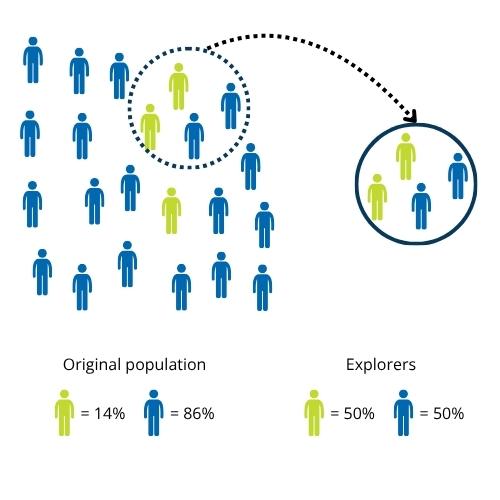
Here’s how the founder effect works. Let’s say a small group of explorers breaks off from a larger population to find a new place to live. People within the group will have a random sampling of the genetic variants from the larger population. This random sampling skews things—some variants become more common within the explorers than they are in the original population, and others become less common.
Let’s also say that the explorers get cut off from the larger population and begin to have children among themselves. The founder effect describes the limited genetic diversity of the individuals that ‘founded’ the new population. Over time, the genetic diversity of the explorers’ descendants will look less and less like the genetic diversity of the larger population they came from. This process explains why some genetic variants show up only in certain groups.
So how does the founder effect play out in genetic testing? One scenario is that, without enough genetic data from people of a certain ancestry, the variant that causes a particular condition within that group might not be linked with the condition. In other words, the variant is sitting in a person’s genetic testing data, but the analysis misses it.
Autoimmune polyendocrinopathy-candidiasis-ectodermal dystrophy (APECED) offers an example. A 2024 paper looked at 17 people with APECED symptoms who went through standard genetic testing but did not receive a genetic diagnosis. The researchers looked carefully at the AIRE gene, the only gene currently linked to APECED. They found the same variant in both copies of the AIRE gene in all 17 people. But, it was labeled as a ‘variant of unknown significance’ (VUS) in genetic databases. Lab experiments showed that the variant did affect the AIRE protein and was likely the cause of APECED in these people.
This is where things get interesting. The researchers noted that 15 of the 17 people with this variant had Puerto Rican ancestry. One of the other two had ancestry from the region in Spain where many colonists originally came from hundreds of years ago. However, the variant had never been linked to APECED because none of the individuals with APECED previously studied shared this ancestry.
The APECED example shows how heavily standard genetic testing analysis relies on spotting variants that have already been linked to the condition in question. However, the variant that causes a particular condition in one group could be totally different from the variant that causes the same condition in another group.
Another study looked at five babies with Inuit or Alaska Native heritage who developed severe viral infections after either receiving a live vaccine or contracting COVID-19. The team found a variant in both copies of the IFNAR2 gene in all five babies. Unlike the APECED example, the variant wasn’t a VUS—it simply wasn’t in the database at all.
As with the APECED variant, the first task was to show in the lab that the variant affects the IFNAR2 protein. Then, the researchers asked how common the variant is among people with the same ancestry as the babies.
Since the publicly available databases clearly had limited representation, the researchers turned to unpublished data from more than 4,000 people in Greenland. They found that about 1 in 25 people with Inuit or Alaska Native ancestry carry the IFNAR2 variant. That means that 1 in 2,500 children born to parents who both have Inuit or Alaska Native heritage will have IFNAR2 deficiency. True to the absence of the variant in genetic databases, the researchers did not find it in anyone with European or East Asian ancestry alone.
In this case, a variant specific to Inuit and Alaska Native populations not only causes a rare PI but also puts people at risk from standard medical care. The researchers are now working on a screening test specifically for babies born within the Arctic Circle. As with the severe combined immunodeficiency (SCID) newborn screening test, the goal is to find babies with IFNAR2 deficiency before they get sick.
Underrepresentation in genetic databases doesn’t just make it difficult to pick out the genetic cause of a PI, it can also make it difficult to rule out other variants. Researchers rely on circumstantial evidence at times and one of the many things they consider is how common a variant is in the general population. The thinking is that variants that cause genetic conditions, particularly life-threatening ones, should be pretty rare overall.
When a group of researchers went looking for the reason that a young girl with Samoan ancestry had severe viral infections, they came up with two good leads. She had a variant in both of her copies of the DOCK8 gene, as well as a variant in both of her copies of the IFNAR1 gene. Previous studies showed that the IFNAR1 variant causes PI with severe viral infections.
But the researchers couldn’t discount the DOCK8 findings. The variant was classified as a VUS but was also rare in genetic databases. Other variants in DOCK8 cause DOCK8 deficiency, a well-known PI with infection risks as well as eczema and allergies. It was possible that the girl had not one but two different PIs.
The founder effect isn’t limited to harmful variants though, it applies to harmless ones too. When the researchers narrowed their definition of ‘general population’ to people with Polynesian ancestry, they found that the DOCK8 variant is actually fairly common. This was the first clue that the girl’s DOCK8 variant might not be harmful. Lab experiments confirmed that it did not affect cells’ ability to make working DOCK8 protein. In this case, careful detective work helped correctly diagnose the girl’s condition and shed light on a common, harmless variant in people with Polynesian ancestry.
The field of diagnostic genetic testing continues to grapple with the lack of data from people with diverse ancestries. It may never be possible to capture every genetically distinct population. However, recognizing how ancestry can influence genetic testing results helps make testing more useful for a broader variety of people and helps healthcare providers know when to dig deeper.

Receive news and helpful resources to your cell phone or inbox. You can change or cancel your subscription at any time.